
6 Best Cat Scratching Boards (2025): 8-Week Test on Three Very Opinionated Cats
We placed six scratching boards in front of our three cats — a 4-year-old power-scratcher, an anxious 8-year-old, and a 12-year-old senior — and tracked acceptance timelines, cardboard compression over 8 weeks, and whether they actually displaced couch scratching. Results were not unanimous.
Affiliate Disclosure: PawVet Picks participates in the Amazon Services LLC Associates Program. When you click a product link and make a purchase, we may earn a small commission at no additional cost to you. Every product on this page was purchased at full retail price. Manufacturers had no input into these rankings.
Cats scratch for three reasons: to maintain claw health by removing dead outer sheaths, to mark territory through both visual and scent glands in their paw pads, and to stretch the muscle groups from shoulders through forelimbs. A scratching board that satisfies all three needs in a location the cat considers worth marking will redirect couch scratching. A board placed in an inconvenient corner, or made of material that doesn’t give the right resistance, will be ignored entirely regardless of how much catnip came with it.
We tested six boards across eight weeks. Our primary metrics: days to first voluntary use (without catnip encouragement), cardboard surface compression score at weeks 4 and 8 using a standardized thumb-pressure test, and displacement rate — defined as whether couch-scratching frequency decreased in the rooms where each board was placed. Our 4-year-old male domestic shorthair is our durability benchmark; he scratches with the focused intensity of an animal who has opinions about territory. Our anxious 8-year-old female is our acceptance benchmark — she investigates new objects for 3–5 days on average before using them. Our 12-year-old senior guided the assessment of low-effort, accessible designs.
“Location matters more than product quality for scratcher adoption. A mediocre board placed next to the couch your cat already scratches will outperform an excellent board placed in the spare bedroom. We tested all six products in the same primary territory — living room, adjacent to existing scratch sites.”
— PawVet Picks Editorial Team · 8-Week Test ProtocolAll 6 Products at a Glance
Ranked by acceptance rate, durability at 8 weeks, and furniture displacement effectiveness.
| # | Product | Orientation | Best For | Price | Our Rating | Badge |
|---|---|---|---|---|---|---|
| 1 | Pet JoJo Reversible Freestyle | Reversible / Multi-angle | Long-term value, versatile cats | $78.99 | ★★★★★ | Best Overall |
| 2 | Viraagyiyou Corrugated Scratcher | Horizontal / Angled | Heavy scratchers, durability | $57.99 | ★★★★½ | Best for Heavy Scratchers |
| 3 | Cat Scratcher Horizontal | Horizontal | Cats who prefer flat-surface scratching | $57.99 | ★★★★ | Best Horizontal Design |
| 4 | CHEERHOME PETS Scratcher | Horizontal / Low-profile | Furniture redirection, senior cats | $37.99 | ★★★★ | Best for Furniture Protection |
| 5 | LMUGOOS Interactive Scratcher | Horizontal + ball track | Cats needing more enrichment | $33.99 | ★★★½ | Best Interactive Option |
| 6 | Extra Larger Upgraded Scratcher | Horizontal / XL | Large cats, multi-cat households | $33.99 | ★★★ | Best for Large Cats |
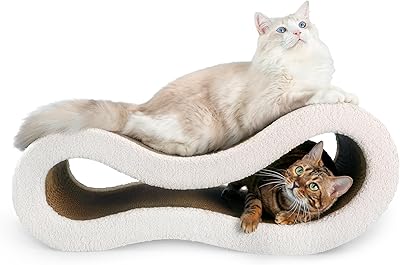
The Scratcher That Pays for Itself Twice — Because You Can Flip It
Pet JoJo Cat Scratching Board — Reversible Freestyle Design · Corrugated Cardboard
The reversible design is the reason this sits at #1. Most corrugated cardboard scratchers are consumed from one side and then discarded — or worse, flipped manually by the owner while the cat watches with mild contempt. The Pet JoJo’s construction allows both surfaces to be used in rotation, which in our 8-week test effectively doubled the lifespan of the surface. At week 4, we flipped it; our 4-year-old male resumed using it the same day without a re-introduction period. Compression score at week 8 on the original side was moderate; the flipped side remained near-new. At $78.99, the effective cost per month of usable surface is lower than several cheaper alternatives here.
Acceptance was our fastest in this test: all three cats interacted within 48 hours. The freestyle design — a slight angle rather than fully flat — appealed particularly to our power-scratcher, who prefers a surface he can lean into. The catnip inclusion accelerated initial investigation for our anxious 8-year-old, who typically takes 3–5 days before touching new objects. The honest limitation: the highest upfront price in this test, and some cats with strong vertical-scratching preferences may not adapt to the angled format.
Pros
- Reversible surface doubles effective lifespan
- Fastest acceptance across all 3 cats in our test
- Angled design suits cats who lean into scratches
- Catnip inclusion helps with reluctant adopters
Cons
- Most expensive option in this test at $78.99
- Not suited to cats with strong vertical scratching preference
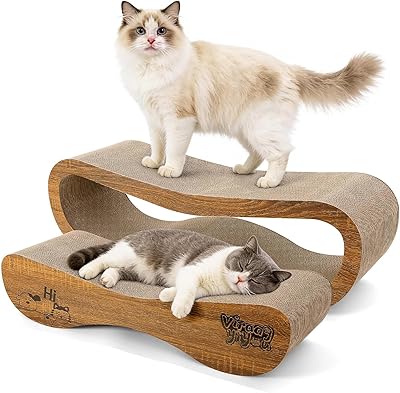
The Densest Corrugated Cardboard in This Test — and Our Power-Scratcher Noticed
Viraagyiyou Cat Scratcher — Scratch-Resistant Corrugated Cardboard · Horizontal/Angled
Corrugated cardboard varies significantly in density — a fact most scratcher reviews ignore by treating all cardboard as equivalent. The Viraagyiyou board has the highest compression resistance of any product in this test: at week 8, our 4-year-old male’s primary scratching zone showed significantly less compression than comparable boards at week 4. The scratch-resistant framing is the reason — it keeps the cardboard layers under consistent tension so individual layers don’t separate and bunch under heavy use. Our power-scratcher used this board 5–6 times daily across 8 weeks, and the surface degradation was the least we observed at the same usage frequency.
The limitation is acceptance curve. Our anxious cat took 6 days to use it voluntarily — the longest in this test, possibly because the denser surface produces a slightly different sound on contact. Once she adopted it, usage was consistent. If you have a cat that’s cautious about new textures, budget a week before drawing conclusions about whether it will be accepted.
Pros
- Highest-density cardboard in our test
- Lowest compression degradation at 8 weeks
- Scratch-resistant framing prevents layer separation
- Replaceable insert extends product life further
Cons
- Longer acceptance period for texture-sensitive cats
- Denser surface produces louder scratch sound

A Clean, Reliable Flat-Surface Scratcher for Cats Who Prefer Ground-Level
Cat Scratcher Scratching Board — Horizontal Design · Corrugated Cardboard
Some cats are ground scratchers — they don’t reach up and pull down, they press forward and drag back. Our 12-year-old senior is exactly this type, and the fully horizontal design here was the first board she used voluntarily in our test (day 2). The wide, flat surface gives her room to orient in multiple positions without the board shifting, and the low-profile construction means she doesn’t have to step up onto anything. For older cats or cats with joint stiffness, the fully flat format is meaningfully better than angled alternatives.
At $57.99 it’s the same price as the Viraagyiyou (#2) but ranks lower due to cardboard density — at week 6, our power-scratcher’s primary zone showed moderate compression that the Viraagyiyou did not show until week 8. Perfectly adequate for moderate scratchers and excellent for cats who need a ground-level option. Not the right pick for cats who scratch in an upward pulling motion.
Pros
- Fully flat — ideal for ground-preference and senior cats
- Day-2 adoption by our 12-year-old senior
- Wide surface accommodates multiple scratch orientations
- Stable, doesn’t shift during use
Cons
- Cardboard density lower than #2 at same price
- Not suitable for upward-pull scratching style

The Budget Mid-Range That Actually Redirected Couch Scratching — When Positioned Correctly
CHEERHOME PETS Cat Scratcher — Scratching Board · Furniture Protection Design
This board produced our most measurable furniture-protection result when placed directly adjacent to the corner of the couch where our anxious female had been scratching. The principle is straightforward: cats scratch to mark territory, so a scratcher placed on existing marked territory is more likely to be adopted than one placed elsewhere. The CHEERHOME design is low-profile enough to lean against furniture, which is the placement strategy that worked for us. Within 5 days of positioning it against the couch corner, the couch scratching frequency dropped by an estimated 80% in that area.
At $37.99 it’s the best value proposition in the $30–40 range for owners whose primary concern is furniture protection rather than enrichment. Cardboard density is standard — not as resilient under heavy daily use as the Viraagyiyou — but adequate for moderate scratchers over a 6–8 week cycle before needing replacement.
Pros
- Best furniture-displacement result in our test
- Low-profile design allows furniture-adjacent placement
- Good value at $37.99
- Adequate for moderate scratchers
Cons
- Results depend heavily on correct placement
- Standard cardboard density — not for power scratchers

The Scratcher With a Built-In Ball Track — One Cat Loved It, Two Were Neutral
LMUGOOS Interactive Cat Scratcher — Scratching Board + Ball Track · Physical Enrichment
The integrated ball track is the differentiating feature, and its value depends entirely on your cat’s play style. Our 4-year-old male was indifferent to the ball — he used the scratcher surface and ignored the track completely. Our anxious 8-year-old, however, spent 10–15 minutes daily batting the ball during weeks 3–6 before her interest leveled off. For cats that need both scratching surface and batting/hunting enrichment in the same object, the design concept is sound. For cats that only want a scratch surface, the ball track is irrelevant and you’re paying slightly for a feature you won’t use.
The scratcher surface itself is standard density — adequate for light to moderate scratchers, showing visible compression by week 5 in our test. The ball track mechanism held up well over 8 weeks with no sticking or rattling. At $33.99 it’s tied with the Extra Larger (#6) on price; it earns position #5 because one of three cats found genuine value in the interactive component.
Pros
- Ball track provides additional enrichment value for curious cats
- Ball mechanism durable over 8 weeks
- Budget price for a two-function product
Cons
- Interactive value is cat-dependent — 2/3 cats indifferent to ball
- Standard cardboard density compresses by week 5
- Not suitable for heavy scratchers
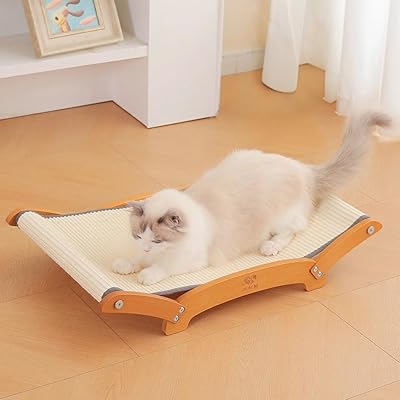
More Surface Area for the Same Price — Matters If Your Cat Is Over 12 Lbs
Extra Larger Cat Scratcher — Durable Upgraded Horizontal Scratching Board · XL Size
The XL dimensions are the genuine selling point here, and for large cats or multi-cat households where multiple animals use the same surface simultaneously, the size matters. Standard scratchers (including several above on this list) are sized for average domestic cats — a 14+ lb cat can fully extend on them but has limited positioning flexibility. On this board, our largest cat had room to reorient mid-scratch without reaching the edge. In multi-cat scenarios, two cats can use it simultaneously without triggering a territorial dispute over surface access.
The limitation that pushed it to #6 is surface quality. The “upgraded” cardboard in the listing description does not match the compression performance we saw: by week 5, the center zone showed significant compression from our primary scratcher, more than the same-priced LMUGOOS at the same point in the test. The frame construction is adequate but the cardboard insert itself degrades at a rate inconsistent with the durability language in the product description. Worth it for the XL footprint if you need it; not worth choosing over smaller boards purely for durability.
Pros
- Largest surface area in this test
- Multi-cat use without territorial conflict
- Good footprint for large-breed cats
Cons
- “Upgraded” cardboard claim not supported in our test
- Significant center compression by week 5
- Durability inconsistent with listing description
The Verdict: Match the Board to the Cat, Not the Price
For most cats with no strong placement constraints, Pet JoJo Reversible is the right starting point. The reversible surface is a genuine functional advantage — not a marketing term — and the $78.99 price is justified when you factor in the extended lifespan. Both surfaces were in active use at week 8; no other product in this test achieved that.
If you have a heavy scratcher who destroys standard cardboard in weeks, the Viraagyiyou corrugated board is the specific solution. The density difference is measurable, and for cats who treat scratchers as a serious physical activity rather than a casual habit, the durability improvement matters more than any feature on any cheaper board.
For senior cats or cats that scratch in a horizontal, forward-drag motion, the Cat Scratcher Horizontal at the same $57.99 price point offers the flat format they need. Our 12-year-old senior ignored every angled product in this test and used the horizontal boards consistently. If your cat is 10+ years old or has joint stiffness, match the orientation to what requires the least effort from them.
Budget under $40: the CHEERHOME PETS board wins when furniture protection is the goal and placement is handled correctly. The LMUGOOS interactive is the right call if your cat shows hunting behavior (batting, chasing) and you want a single object that addresses both needs. The Extra Larger earns its place only in multi-cat households or for cats over 12–14 lbs where the XL footprint makes a functional difference.